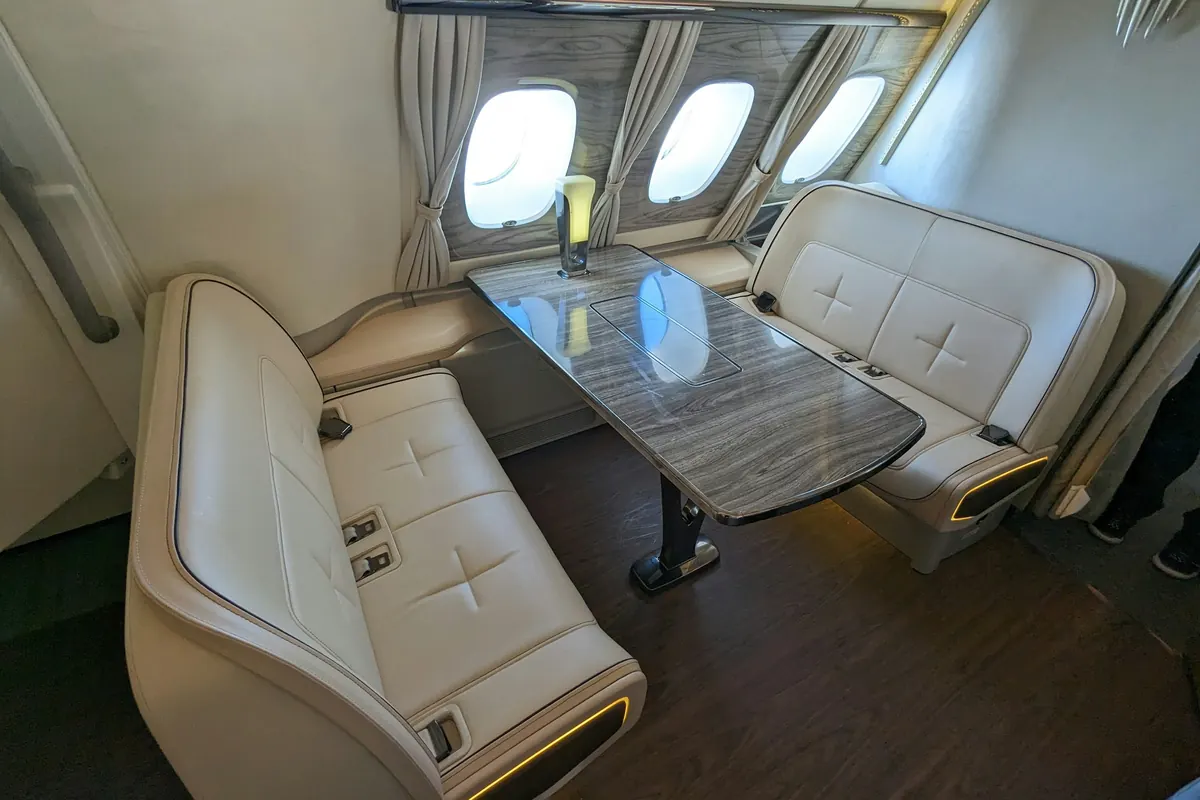
There are two ways to fly privately without paying for an aircraft on your own. You can buy a seat on a flight that someone else has organised, or you can charter the whole aircraft and split it with your own group. Both put you in a private terminal and a small cabin. They differ in price, control and certainty, and the right answer depends mostly on how many of you are travelling.
What per-seat options look like
Per-seat flying comes in a few forms. Some operators run shared or semi-private services on busy routes, selling individual seats on set departures. Others sell seats on charter flights they organise around popular dates and events. And occasionally a seat or a whole cabin comes up on a repositioning flight, sold at a discount because the aircraft is flying that way anyway.
What they have in common is that the operator sets the route, the date and the time. You buy a seat and fit your plans around the flight.
How whole-cabin pricing works
A charter is priced per aircraft, not per person. The operator charges an hourly rate for the flight time, plus the 7.5% federal excise tax on domestic trips, segment fees, and costs such as repositioning, landing fees and crew overnights. That total is the same whether one person flies or every seat is filled, which is why your group size matters so much.
The math for a light jet
Take a light jet at an estimated $3,500 to $5,500 an hour. For a one-hour flight, including the excise tax, the aircraft costs roughly $3,760 to $5,910. Divide it by your group:
| Group size | Each person's share, est. |
|---|---|
| 1 traveller | $3,760–5,910 |
| 2 travellers | $1,880–2,960 |
| 3 travellers | $1,250–1,970 |
| 4 travellers | $940–1,480 |
| 5 travellers | $750–1,180 |
| 6 travellers | $630–990 |
| 7 travellers | $540–840 |
Compare that with any per-seat fare you have been offered for the same trip. For one or two travellers, a per-seat option usually wins on price by a wide margin. By four or five, a whole cabin can be competitive. With a full cabin, your own aircraft often costs each person less than buying the same number of seats would.
Try it with your numbers. The cabin planner does this for every category and any flight time, and shows what happens to a one-way when the empty return is included.
What the price doesn't show
Control of the schedule
With your own cabin, the aircraft leaves when your group is ready, from the airport that suits you, and comes back when you want. With a seat, you keep to the operator's timetable, and if the flight moves, you move with it.
Certainty
Some shared flights only operate once enough seats are sold, and seats on repositioning flights can be cancelled if the original trip changes. Ask what happens if a per-seat flight doesn't go, and keep a backup plan for anything time-critical.
Privacy and comfort
Sharing a cabin with strangers is perfectly pleasant on a short hop, but it isn't the same as your own space for a family, a team meeting or a quiet flight.
Bags, pets and children
Per-seat services tend to set firm baggage allowances and their own pet rules. On a whole-cabin charter, the operator plans around what you bring, within the aircraft's limits. Families with car seats, strollers and a dog usually find the whole cabin simpler.
How shared seats are sold
A per-seat purchase is not a charter agreement. The seat provider sets its own terms for changes, cancellations, baggage and pets, and they can differ a great deal from one service to the next. Read them before you buy, and check what happens to your seat if the departure moves or does not operate.
Seats on repositioning flights
Occasionally an operator offers individual seats on an empty leg, or the whole aircraft at a discount. These can be excellent value for a flexible traveller, but the route and time are fixed and the flight depends on the original booking. Treat them as a bonus when they appear rather than a plan to rely on.
A worked comparison
Suppose three friends want to fly for about an hour. Using the light jet estimate above, each person's share of the whole cabin comes to roughly $1,250 to $1,970. If a shared flight on the same route and day sells seats for less than the low end of that range, the seats win clearly. If seats cost more than the high end, chartering the cabin wins and the three of them keep the schedule. In between, it comes down to timing, bags and how much the privacy is worth.
A simple way to decide
- One or two travellers, flexible plans: look for seats first, with a whole-cabin quote as the fallback.
- Three to five travellers: price both. The answer depends on the route and the fare.
- Six or more, or a fixed schedule: start with the whole cabin, choose the category that seats you comfortably, and compare its share with a size smaller or larger.
Whichever way you fly, the standards don't change. Every flight we arrange is operated by a certificated FAA Part 135 carrier or the foreign equivalent, in operational control of the aircraft, and every quote shows the operator, the aircraft and the all-in price before you commit.
It also helps to decide early who in the group is flexible. If two people can travel at the shared flight's time and the rest cannot, a mix of seats and a smaller cabin may be the cheapest answer of all.
Asking for both
When you request a quote, give the number of seats and say if you'd consider a shared flight. Your advisor will check per-seat options on your route and date and, alongside them, price whole-cabin aircraft with each person's share. You then compare like with like, in plain numbers, and choose.