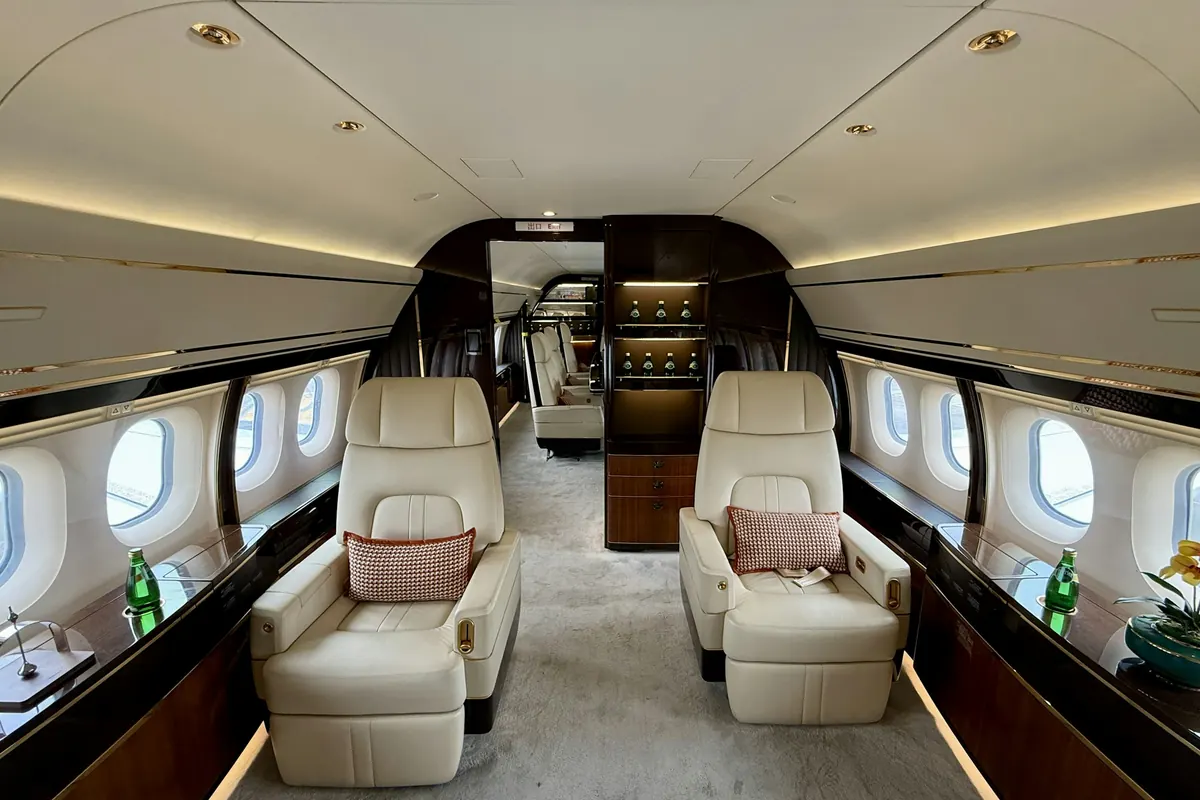
Operators describe their aircraft with seat maps, and at first glance they all look alike: a row of rounded rectangles inside a long outline. Learn to read one and you can tell, before you book, whether a cabin will feel spacious or full, where the bags go and which seats your group will fight over.
Start with the outline
Seat maps are drawn from above, usually with the nose pointing to one side. The entry door sits near the front, behind the cockpit, and often on the left. Near the door you'll find a small galley or refreshment cabinet. At the back is the lavatory, and on many aircraft a baggage compartment behind it. Everything between those two points is the passenger cabin, and the way seats are arranged inside it tells you most of what you need to know.
The seat types
Most private jets combine a handful of seat types. Once you can name them, any seat map makes sense.
| Seat type | Where it is | Good for | Watch for |
|---|---|---|---|
| Club seat | Groups of four facing each other, often around fold-out tables | Conversation, meals, working together | Facing seats share legroom |
| Forward-facing seat | Aft of the club or in pairs | Travellers who dislike riding backwards | Fewer of them than you might expect |
| Aft-facing seat | Front half of a club group | Most people never notice the difference | Ask to swap if it bothers you |
| Divan | Side-facing sofa along one wall | Lounging, and sleeping on longer flights | Often counted as two or three seats |
| Belted lavatory | Toilet seat certified for takeoff and landing | Making a full cabin legal | Not a seat anyone wants for long |
Club seats
The club four is the signature of a private cabin: two pairs of seats facing each other, with a table that folds out between them. These are usually the most comfortable seats on board. The trade-off is legroom. Facing seats share the space between them, so four tall travellers in a light jet club will be negotiating knees.
Divans
A divan is a side-facing sofa. On midsize and larger jets it is often certified for two or three people during takeoff and landing, and on longer flights it can become a bed. It is a lovely place to stretch out with a small group, and the least popular seat with a full one.
The belted lavatory
On some light and midsize jets, the lavatory seat has a seatbelt and is certified for takeoff and landing. That lets the aircraft carry one more passenger, and it is why a cabin advertised as eight seats can feel like seven. If your group would fill every seat, ask whether one of them is the lavatory.
Height and width matter more than seat count
A seat map doesn't show the third dimension. Cabin height ranges from under five feet in turboprops and very light jets, through about 4.8 to 4.9 feet in light jets and about 5.7 feet in a midsize, to about six feet in a super-midsize and 6.2 feet or more in large cabins. In practice, most adults can stand upright from a midsize upward, and stoop in anything smaller.
Width follows the same pattern. Larger cabins fit wider seats and a real aisle, which is what makes a four-hour flight feel short.
Where the bags go
Look for the baggage compartment on the plan. On many light jets it is external, loaded from outside and not reachable in flight, with a smaller space in the cabin for coats and bags you'll want. Larger aircraft often have an internal compartment you can reach during the flight. Skis, golf clubs and large hard cases are worth listing in your request, because the operator plans weight and space around them.
Galley, windows and light
The small block near the door on most seat maps is the galley. On a light jet it is usually a refreshment cabinet with ice, drinks and snacks; on larger aircraft it can be a full galley with an oven and a coffee maker, which matters on a long morning flight. Windows tell you something too: count them along one side and you have a fair sense of the cabin's length, and seats lined up with windows make for a brighter, calmer trip.
How seat counts can mislead
A seat count is the maximum number of passengers the aircraft is configured to carry, not the number who will be comfortable. It may include a divan counted as three, a side-facing seat near the door and a belted lavatory. A useful habit is to take the advertised number and subtract one or two to find the comfortable number for your group, especially on longer flights.
A quick test. Count the seats that face forward or aft in a club or pair. If your whole group fits in those, the cabin will feel generous. If people end up on the divan and the side seat, it will feel full.
Seat maps also show where the cabin is noisiest. On jets with engines at the rear, the last row hears them most; seats over the wing usually feel the smoothest in light turbulence.
Questions to ask before you book
- Can you send the seat map for this specific aircraft, not the type in general?
- Is one of the seats a belted lavatory, and is the lavatory enclosed?
- Where is the baggage compartment, and can we reach it in flight?
- Which seats recline fully, and does the divan convert to a bed?
- How much baggage can we carry with every seat filled?
Your advisor can answer all of these with the quote. A seat map you understand is the easiest way to make sure the cabin you book is the one your group will enjoy, not just the one with the right number on it.